
What Separates Random UGC From Structured Testing
Why most brands do not have a content problem. They have a systems problem.
Ziyad Haijar
Avora
Introduction
A lot of brands think they are "doing UGC."
Technically, maybe they are.
They hired a creator. Got a couple videos. Maybe tried one or two hooks. Posted them. Ran them. Moved on.
That is not really a content system. That is just content happening.
And that is the problem.
Because when brands say UGC "doesn't work," a lot of the time what they really mean is this:
They never gave themselves enough structure, volume, or clarity to learn what actually worked.
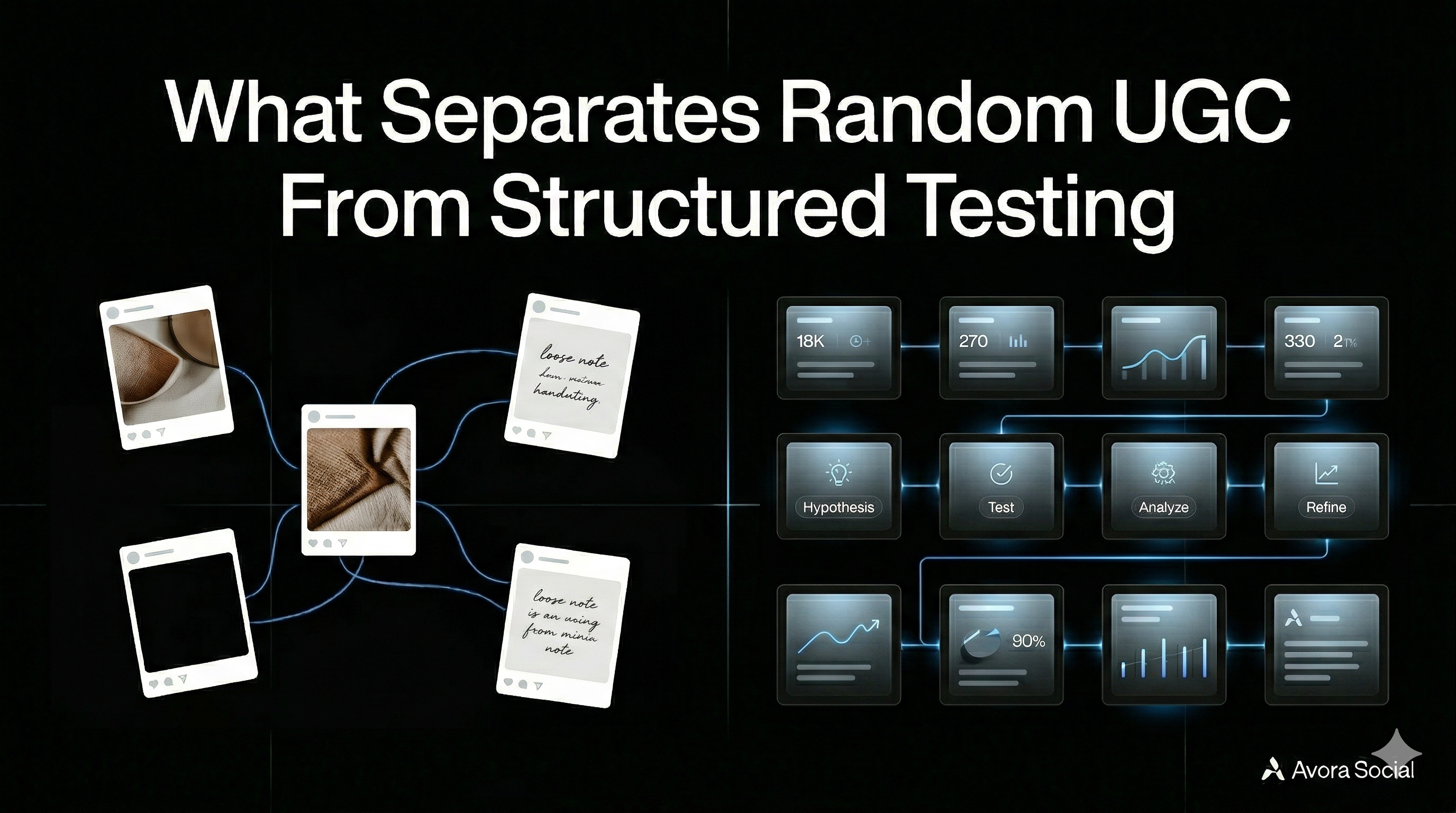
Random UGC and structured testing are not the same thing.
Not even close.
What random UGC usually looks like
Random UGC usually starts with good intentions.
A brand wants fresher content. They know short-form matters. They know creator-led content feels more native. So they start reaching out.
Then the usual thing happens.
A few creators get sourced with no real system behind it. The briefs are vague. The hooks are weak. The output is inconsistent. One video feels polished, the next feels off-brand, the next feels unusable.
And because there was no real testing structure in the first place, nobody knows what the outcome actually means.
Did the angle fail?
Did the creator fail?
Did the edit fail?
Was the message wrong?
Was the concept fine, but the delivery weak?
Nobody knows.
So the brand either keeps guessing or concludes that UGC is overrated.
That happens all the time.
What structured testing looks like instead
Structured testing is different because it is built around learning.
Not just producing.
That means starting with a few things that are actually intentional:
- • what angles are being tested
- • what audience reactions are being looked for
- • what creator styles fit the concept
- • what kind of messaging deserves multiple variations
- • what should be doubled down on if it works
The point is not to pretend every video will win.
The point is to make sure every round of content teaches you something useful.
That is where things start getting more efficient.
Because once there is structure, content stops being random output and starts becoming feedback.
And feedback is where better creative comes from.
Why one-off videos usually fail
One-off videos fail because they carry too much pressure.
A brand gets one creator, one concept, one shot — and expects that one asset to somehow prove whether a whole channel works.
That makes no sense.
Good short-form usually comes from iteration, not from one lucky guess.
One version tells you almost nothing.
A small testing system tells you a lot more:
- • what the audience stops for
- • what kind of creator feels believable
- • what tone feels natural
- • what message is actually resonating
- • what deserves a second or third variation
That is how stronger creative gets built.
Not by asking one video to do all the work.
The real shift
The real shift is moving from:
"let's make some UGC"
to:
"let's build a testing system around creator-led content."
That sounds small, but it changes everything.
Because once that shift happens, content stops being a random marketing activity and starts becoming part of a real process.
That is when creators get chosen more intentionally. Briefs get sharper. Edits get better. Messaging improves. Patterns become easier to spot.
And over time, the output gets stronger because the thinking behind it gets stronger.
Why this matters for brands
Brands do not need more content just for the sake of it.
They need more clarity around what kind of content is actually worth producing again.
That is the real value of structured testing.
Not just more videos.
Better judgment.
Because once a brand starts seeing what actually resonates, the whole creative process gets better:
- • the briefs improve
- • the concepts get sharper
- • the creator fit gets stronger
- • the content starts feeling less forced
- • the next batch gets smarter than the last
That is what random UGC rarely gives you.
Structured testing does.
The bigger point
UGC is not broken.
A lot of the time, the way brands approach it is.
If the process is random, the results usually feel random too.
But when content is creator-led, structured properly, and tested with intention, it becomes a lot more useful than just "something to post."
It becomes a system for finding better creative.
And that is the difference that matters.
Let’s build a content system that actually performs
If you’re a B2C app or consumer brand looking for stronger creator-led short-form content, let’s see if we’re a fit.
Book a call